2026 Top Greenhouse Pipe Types for Global Buyers
Choosing the right Greenhouse Pipe can determine whether a structure survives one season or supports production for decades. Global buyers now compare more than price. They examine load strength, corrosion resistance, installation speed, transport weight, and long-term maintenance.
This 2026 guide reviews common pipe types, including galvanized steel, aluminum, stainless steel, and PVC options. Each material performs differently under heat, humidity, snow, wind, and salty coastal air. A galvanized steel pipe may suit large commercial houses with heavy coverings. Aluminum can reduce structural weight and simplify assembly. PVC may support smaller tunnels, but sunlight and temperature changes require careful evaluation.
Real projects reveal practical details. A rough pipe surface can damage plastic film during installation. A weak connection may loosen after repeated wind movement. Even a small diameter difference can affect clamps, arches, and replacement parts. Buyers should request coating thickness, tensile data, dimensional tolerances, and test documentation from suppliers. Independent inspection can also reduce costly surprises.
There is no universal winner.
Climate, span, covering material, and local workmanship change the decision. This article uses industry specifications and field-based considerations to compare performance across regions. Still, some recommendations remain conditional. Supplier quality varies, and published data may not reflect harsh farm conditions. A sample assembly and site trial are often wiser than relying on a catalog alone. The goal is not to promote one material, but to help buyers select a dependable Greenhouse Pipe system with clearer evidence and fewer avoidable mistakes.
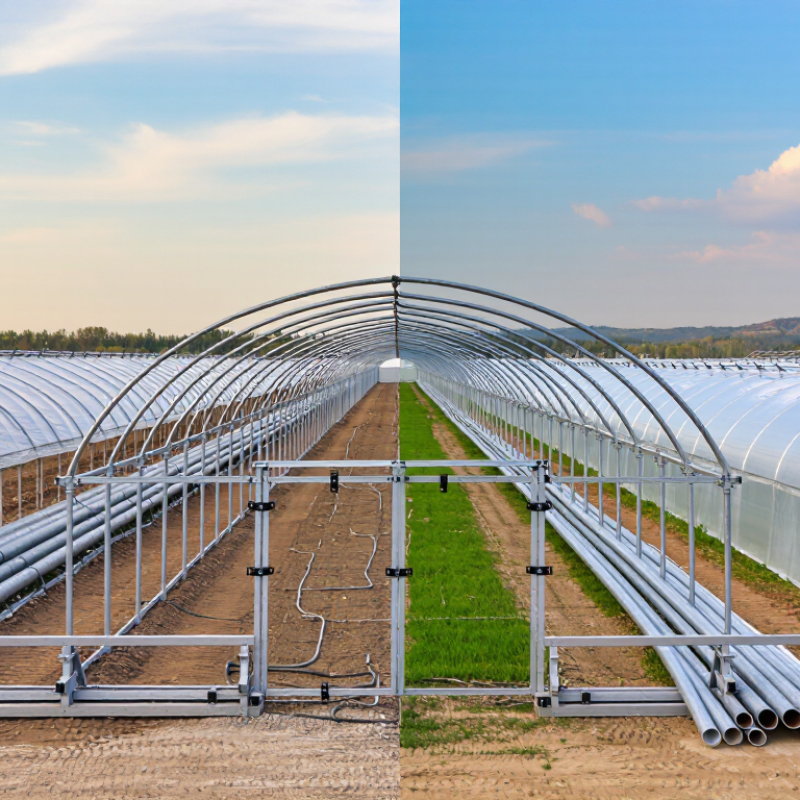
Greenhouse Pipe Basics: Functions, Materials, and Selection Factors
2026 Top Greenhouse Pipe Types for Global Buyers
Greenhouse Pipe Basics: Functions, Materials, and Selection Factors
Greenhouse pipes support the structure, guide plant growth, and move water or heat. Their function determines the correct pipe type. Arched hoops create the main frame, while purlins connect hoops and resist wind movement. Ground anchors improve stability. Irrigation pipes need smooth internal surfaces and reliable pressure performance. Heating pipes must tolerate repeated temperature changes without deforming.
Galvanized steel remains a practical choice for frames exposed to rain and humidity. Its zinc coating slows corrosion, but damaged cuts can still rust. Aluminum is lighter and easier to handle, though it may require stronger connections under heavy wind or snow. PVC and HDPE suit irrigation because they resist moisture and are simple to install. However, sunlight, freezing temperatures, and pressure can reduce their service life. Not every plastic pipe belongs outdoors.
Selection should begin with local climate data, not only purchase price. Check wind speed, snow load, humidity, soil condition, and available replacement parts. Pipe diameter and wall thickness affect strength, bending, and connection reliability. Inspect coating thickness, welding quality, UV resistance, and compatible fittings before ordering. A pipe that performs well in a dry region may fail quickly near salt air. This is easy to overlook. Field installation also matters; poor alignment can weaken even a well-made system. When project data is incomplete, choosing the strongest-looking pipe is not always sensible. A qualified structural engineer or experienced installer should verify the design.
Key Greenhouse Pipe Types and Their Structural Applications
2026 Top Greenhouse Pipe Types for Global Buyers
Greenhouse pipe selection depends on load paths, climate, and maintenance access. Round galvanized steel pipes remain common for arches, braces, and purlins. Their curved profile distributes wind pressure efficiently, while hot-dip galvanizing improves corrosion resistance in humid interiors. Rectangular hollow sections suit columns, door frames, and heavy roof beams because their flat faces simplify bolted connections. They often require careful drainage at open ends.
Aluminum pipes are useful for ventilation frames and movable roof components. They are lighter, but usually less economical for primary structures under high snow loads. PVC and polyethylene pipes serve irrigation and fertigation systems, not structural framing. They resist chemicals well, though ultraviolet exposure can make lower-grade plastics brittle. Small details matter.
The 2024 MarketsandMarkets greenhouse market report projects growth from about USD 37.8 billion in 2024 to USD 57.1 billion by 2029. This expansion increases demand for standardized structural tubing, but market estimates vary by methodology. FAO reports that protected cultivation can improve water and land-use efficiency, although performance depends strongly on design and operation. Buyers should compare pipe diameter, wall thickness, zinc coating, connection method, and local wind or snow requirements. A thicker pipe is not automatically safer. That assumption deserves review. Surface rust around cut edges remains an overlooked failure point.
Comparing Steel, Aluminum, PVC, and Composite Greenhouse Pipes
2026 Top Greenhouse Pipe Types for Global Buyers
Steel, aluminum, PVC, and composite pipes each solve different greenhouse problems. Steel offers high stiffness for snow loads, hanging crops, and wide spans. The World Steel Association reports that steel remains one of the world’s most recycled materials. However, unprotected steel can corrode quickly in humid, fertilizer-rich air. Galvanized coatings help, but cut edges and drilled holes still need attention.
Aluminum is lighter and naturally corrosion-resistant, making installation easier on remote sites. The International Aluminium Institute reports that recycling aluminum uses about 95% less energy than primary production. PVC is affordable, electrically insulating, and suitable for small tunnels or irrigation supports. Yet heat, ultraviolet exposure, and cold impact can reduce its service life. PlasticsEurope reported global plastics production at about 400 million tonnes in 2022, but total production does not prove greenhouse durability. Composite pipes resist rust and can reduce handling weight. Their stiffness, connection strength, and repair options vary widely. The evidence is less consistent. Buyers should be cautious.
Tips: Match pipe choice to climate, span, load, and maintenance skills. Check wall thickness, coating mass, UV testing, and connector compatibility. For coastal sites, test fasteners separately. For snow regions, request a structural calculation, not a sales estimate. I have seen lightweight frames save labor, then lose value through weak joints. Material selection is rarely perfect. Recheck the assumptions.
2026 Top Greenhouse Pipe Types for Global Buyers
Comparing Steel, Aluminum, PVC, and Composite Greenhouse Pipes
This chart compares representative material density, expressed in kilograms per cubic metre. Lower density can reduce the dead load of a greenhouse frame, while steel generally provides high stiffness and strength. Aluminum offers lower weight and good corrosion resistance, PVC is lightweight and economical for selected applications, and glass-fiber-reinforced polymer composites combine low weight with corrosion resistance. Actual performance depends on pipe diameter, wall thickness, grade, reinforcement, temperature, wind, snow, and connection design.
Indicative engineering values: carbon or galvanized steel ≈ 7,850 kg/m³; aluminum alloys ≈ 2,700 kg/m³; rigid PVC ≈ 1,400 kg/m³; glass-fiber-reinforced polymer composites ≈ 1,800 kg/m³. Values vary by specification and manufacturing process.
How Climate, Coatings, and Standards Shape Global Pipe Selection
Climate now changes greenhouse pipe selection. The WMO State of the Global Climate 2023 report recorded 2023 as approximately 1.45°C above the pre-industrial average. Hotter summers increase ventilation loads, while stronger storms demand better structural margins. In humid coastal zones, hot-dip galvanized steel pipes usually offer stronger protection than untreated carbon steel. However, salt exposure can still attack cut edges and welds. Coating is not a magic shield.
Water quality matters too. FAO AQUASTAT reports that agriculture uses about 70% of global freshwater withdrawals. Recycled or saline irrigation water can accelerate corrosion inside irrigation lines. Polyethylene pipes suit flexible water distribution, while rigid steel pipes remain useful for frames, gutters, and high-load spans. Aluminum reduces weight, but its cost and connection details require careful evaluation. Small design choices matter.
Standards make comparisons more reliable. Buyers should check coating requirements under ISO 1461 or ASTM A123, and review steel dimensions against applicable EN or ASTM specifications. Test certificates should identify zinc thickness, yield strength, wall thickness, and batch traceability. Field inspection is still necessary. A certificate cannot reveal careless drilling or damaged coatings. I have seen “compliant” pipes fail at unprotected joints. Global buyers should also consider local wind, snow, ultraviolet exposure, soil chemistry, and replacement access. The cheapest pipe may become the most expensive decision.