
What Is the Best Cereal Bar Machine in 2026?
Choosing the best Cereal Bar Machine in 2026 requires more than comparing polished brochures. A reliable machine should handle oats, nuts, syrups, and dried fruit without crushing delicate ingredients. It should also produce bars with consistent weight, clean edges, and stable moisture. Small differences matter. A two-gram variation can affect packaging, nutrition labels, and customer expectations.
Dr. Richard W. Hartel, a respected food engineering professor, highlights a practical principle: “Moisture migration can determine product quality.” This insight is highly relevant to cereal bar production. A machine with accurate heating, gentle mixing, and controlled compression can protect texture during busy production shifts. Operators should inspect temperature sensors, conveyor speed, cutting accuracy, cleaning access, and changeover time. These details often reveal more than advertising claims.
Still, no machine is perfect. One model may offer excellent speed but require difficult maintenance. Another may deliver precise portions but occupy too much factory space. My evaluation would include trial batches using the company’s actual recipe, not only standard samples. I would check the first bar, the hundredth bar, and the final bar. Performance can change as syrup builds on rollers or ingredients warm. The best Cereal Bar Machine is therefore the one that matches production volume, recipe behavior, labor skills, and food-safety procedures. Price matters. Yet downtime may cost more. This guide compares those practical realities, while recognizing that equipment recommendations deserve careful testing before purchase.
What Is a Cereal Bar Machine and How Does It Work?
What Is the Best Cereal Bar Machine in 2026?
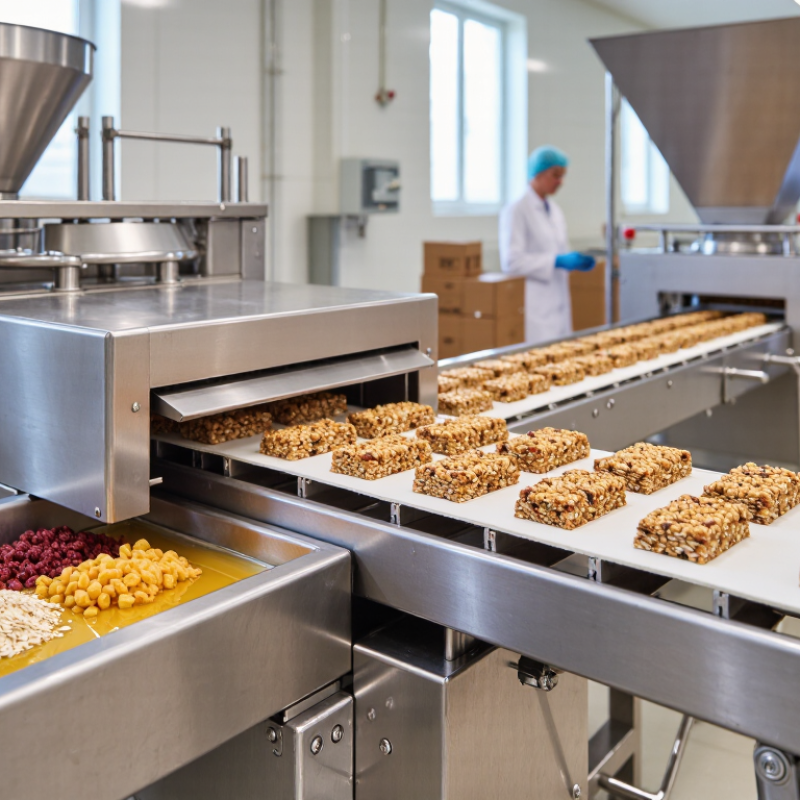
A cereal bar machine converts prepared grains, syrup, and inclusions into uniform snack bars. The process usually begins with a weighing hopper and heated mixer. The mixer combines oats, puffed grains, nuts, and binding syrup at a controlled temperature. A forming unit then spreads the mixture into a continuous slab. Calibrated rollers control thickness before a guillotine or ultrasonic cutter creates individual bars. Finally, a cooling conveyor firms the structure before wrapping.
The details matter. A small temperature change can make bars crumble or become sticky. According to Grand View Research’s 2024 snack bars report, the global snack bars market was valued at more than 18 billion dollars in 2023. This growth increases demand for stable production, accurate dosing, and faster changeovers. A 2024 PMMI packaging industry report also highlights automation, digital monitoring, and hygienic design as major food-processing priorities. These features help operators track weight, temperature, and downtime.
The best machine in 2026 is not automatically the fastest one. It should offer tool-free cleaning, accessible contact surfaces, servo-controlled cutting, and recipes that can be adjusted quickly. My practical concern is often overlooked: a machine may perform perfectly with soft bars but struggle with dense protein mixtures. Factory trials are essential. A specification sheet cannot show every sticky corner. Operators should test the actual recipe, packaging speed, cooling time, and daily cleaning routine before purchasing. Small errors become expensive at scale.
