
What Are the Best Types of Dual Exhaust Systems?
A Dual Exhaust System can change more than the sound behind your vehicle. Its layout affects exhaust routing, ground clearance, installation cost, and how easily the system fits your engine and chassis. That makes “best” a practical choice, not a universal winner. SEMA’s 2024 Market Report estimated U.S. specialty-equipment sales at $52.3 billion in 2023, reflecting strong interest in vehicle upgrades. Still, market demand does not prove that every modification improves performance.
The EPA’s 2024 Automotive Trends Report estimated average real-world fuel economy for model-year 2023 vehicles at 27.1 miles per gallon. That figure is useful context, but it does not show that dual exhaust alone raises or lowers fuel economy. Vehicle design, engine tuning, pipe diameter, muffler choice, and driving conditions all matter. Small details count. A poorly matched setup may add noise without delivering useful gains. This guide compares true dual, dual-outlet, and crossover configurations, while explaining their trade-offs in sound, fit, and performance. It also separates measurable factors from common claims, because exhaust results vary from one vehicle to another. Frankly, the perfect system is sometimes less exciting than expected. Check vehicle-specific fitment and reliable test data before choosing.
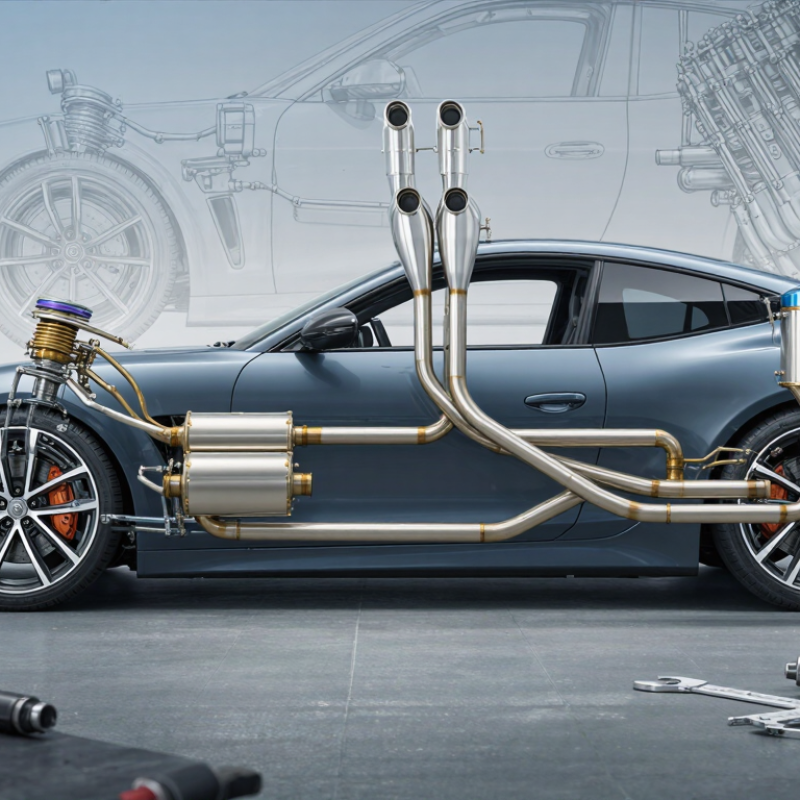
How Dual Exhaust Systems Are Configured
Dual exhaust describes several layouts, not one fixed arrangement. A true dual system gives each bank of a V-shaped engine its own exhaust path. The pipes may run separately from the manifolds to the rear, with one muffler and tailpipe on each side. It can look balanced beneath the car. Clearance still matters.
A crossover changes how those paths interact. An H-pipe joins the pipes with a short cross-connection, while an X-pipe merges and divides their flow more gradually. Placement affects sound and pressure behavior, so the best position depends on engine design and available space. There is no universal winner. Even small bends can matter.
Other systems use one main pipe that splits near the rear, creating two visible outlets without two fully independent paths. This layout may simplify packaging, especially where the chassis leaves little room. Inspect the routing around the driveshaft, fuel tank, suspension, and heat-sensitive parts. A neat drawing can hide a cramped fit. Measure carefully. Muffler location, pipe diameter, and outlet position also shape noise, ground clearance, and maintenance access. A qualified exhaust technician can verify fitment and check for leaks after installation.
