147 Mill Ridge Rd Suite 232
Lynchburg, Virginia 24502
Phone 757-982-3665

Best Galvanized Steel Coil Manufacturer in China?

Choosing the best Galvanized Steel Coil Manufacturer in China requires more than comparing prices or browsing polished websites. A reliable decision begins with measurable production evidence. Buyers should examine steel grade, zinc coating mass, coil width, thickness tolerance, surface finish, and packing quality. These details affect performance long after the shipment leaves the factory.

Dr. Frank Goodwin, a recognized zinc-industry specialist, has explained: “Zinc protects steel through barrier protection and sacrificial, cathodic protection.” This principle matters in construction, automotive components, roofing, appliances, and industrial fabrication. A capable Galvanized Steel Coil Manufacturer should understand both protection mechanisms and their practical limits.

Look closely at the mill.

A serious producer can provide material certificates, coating test results, inspection records, and traceable production numbers. It should also discuss ASTM, EN, JIS, or GB requirements clearly. Vague promises are not technical evidence. Ask how the factory controls bath temperature, zinc composition, strip tension, cooling, and recoiling. Small process variations can create uneven coating, edge damage, or surface marks.

Experience matters, but it is not enough. A large factory may still respond slowly or handle complaints poorly. A smaller manufacturer may offer better communication and flexible production. This comparison can be uncomfortable.

No supplier is perfect.

Therefore, this guide evaluates Chinese manufacturers through quality control, production capacity, export experience, customization ability, delivery reliability, and after-sales support. It also considers an often-neglected issue: whether the supplier’s documents match the actual coils. Samples, factory audits, and independent inspections remain useful. A confident conclusion should be based on evidence, not attractive claims.

Best Galvanized Steel Coil Manufacturer in China?

What Is Galvanized Steel Coil?

Galvanized steel coil is carbon steel protected by a zinc coating. Most coils use a hot-dip process, where cleaned steel passes through molten zinc. The zinc bonds closely with the surface and creates sacrificial protection. When moisture reaches exposed steel, zinc corrodes first. This delays rust and extends service life. Galvanized coil can be slit, roll-formed, painted, or pressed into roofing panels, ducts, automotive parts, and structural components. Coating mass, steel grade, thickness, and surface finish affect its performance.

When evaluating a manufacturer, request coating test results, dimensional tolerances, and batch traceability. Practical inspection may include a micrometer check, coating-gauge reading, bend test, and visual review. A bright surface can look excellent but still hide uneven coating. That assumption is not always correct. Storage also matters. Keep coils dry, raised from the floor, and separated with spacers. Trapped moisture can create white rust before installation.

Tips: Match the zinc coating to the environment. Coastal and humid areas usually need stronger protection. Confirm applicable standards before ordering. Ask for a sample and inspect the edges, where defects may appear first. Do not choose only by the lowest price. A cheaper coil may have thinner coating or inconsistent dimensions. The mistake is easy to make.

The chart compares common galvanized steel coil coating designations by total nominal zinc coating mass on both sides. Higher coating mass generally provides greater protection against atmospheric corrosion. Values are based on ASTM A653 coating designations and are shown in both ounces per square foot and grams per square metre.

How Galvanized Steel Coil Is Manufactured in China

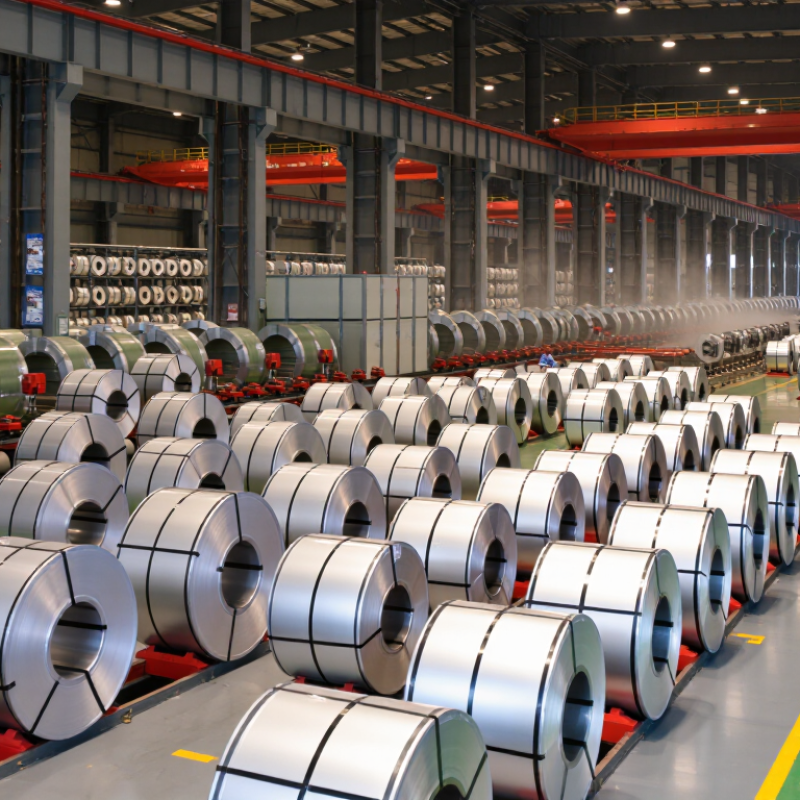
In China, galvanized steel coil production begins with carefully inspected cold-rolled steel. Technicians check thickness, surface condition, and mechanical strength before processing. The strip then passes through cleaning tanks that remove oil, dust, and iron particles. The process looks simple. It is not.

After cleaning, the strip enters an annealing furnace. Controlled heat softens the steel and prepares its surface for zinc bonding. It then moves through a molten zinc bath, usually near 450°C. Air knives remove excess zinc and control the coating thickness. Small variations matter. Line speed, bath temperature, and air pressure must remain closely balanced.

The coated strip receives cooling, skin-pass rolling, and tension leveling. These steps improve flatness and reduce minor surface defects. Inspectors measure coating mass, width, thickness, adhesion, and appearance. Samples may also undergo bending and impact checks. Experienced teams record every adjustment, because production data often reveals problems before customers do. Still, no line is flawless. A rushed setup can cause uneven coating or edge damage. Careful packaging, moisture protection, and traceable inspection records help prevent those issues during storage and shipment.

Key Standards and Quality Requirements for Galvanized Steel Coils

Best Galvanized Steel Coil Manufacturer in China?

Key Standards and Quality Requirements for Galvanized Steel Coils

A reliable galvanized steel coil supplier should prove compliance, not merely promise it. ASTM A653 and EN 10346 define coating, steel grade, dimensions, and mechanical requirements. Under both systems, G90 and Z275 represent about 275 g/m² of zinc across both surfaces. That figure matters. It is not the zinc weight on one side.

Factory experience shows that coating mass alone cannot predict service performance. Buyers should check tensile strength, yield strength, elongation, bending behavior, and coating adhesion. Surface defects deserve close attention. Look for bare spots, zinc flakes, edge cracks, and uneven spangle near the coil edge. Small defects can become visible after forming.

Use independent testing when the application is demanding. Test reports should identify heat number, coil number, coating designation, thickness, width, and test methods. ISO 9001 certification supports process control, but it does not replace product testing. World Steel Association data placed global crude steel production near 1.9 billion tonnes in 2023, showing the scale of this supply chain, but scale does not guarantee consistency. That is an easy mistake.

I would also verify each batch.

A clean surface may still hide poor adhesion. Sampling only the coil head is insufficient; the middle and tail can differ. ASTM A653, EN 10346, and ISO 1461 are useful references, although ISO 1461 mainly addresses fabricated galvanized products. Requirements should match the forming method, environment, and expected service life. Overlooking those details can make a low-priced coil expensive later.

Best Galvanized Steel Coil Manufacturer in China? - Key Standards and Quality Requirements for Galvanized Steel Coils

Quality Dimension Relevant Standard or Reference Key Requirement or Typical Data Recommended Verification Method
Base Steel Type ASTM A653/A653M, EN 10346, JIS G3302 Common substrates include commercial quality, forming quality, structural steel, and high-strength low-alloy steel. Review the product certificate, steel grade designation, chemical composition, and mechanical test results.
Zinc Coating Designation ASTM A653/A653M Typical designations include G30, G60, and G90. The number represents the total coating mass on both sides in oz/ft². G60 is approximately 183 g/m² and G90 is approximately 275 g/m². Use a coating-mass test or X-ray fluorescence measurement, with results reported for both sides where applicable.
Zinc Coating Designation EN 10346 Common designations include Z100, Z140, Z200, Z275, and Z350. The number generally indicates the minimum total coating mass on both sides in g/m². Confirm the coating designation and total coating mass against the purchase specification and inspection certificate.
Zinc Coating Designation JIS G3302 Common coating classes include Z12, Z18, Z20, Z22, Z25, and Z27; the selected class should be matched to the required corrosion protection and forming performance. Check the JIS coating-class designation and verify coating mass using an approved test method.
Coating Uniformity ASTM A653/A653M, EN 10346, ISO 1460 Coating must be continuous and reasonably uniform. Local coating variation may occur because of strip position, bath chemistry, air-knife control, and line speed. Perform a gravimetric coating-mass test, magnetic or electromagnetic thickness measurement, and visual inspection.
Surface Appearance ASTM A653/A653M and EN 10346 appearance requirements The surface should be free from harmful defects such as significant uncoated areas, peeling, flaking, cracks, excessive roughness, and severe scratches. Inspect both coil surfaces under suitable lighting and define acceptable defect limits before production.
Spangle and Surface Finish ASTM A653/A653M, EN 10346 Regular spangle, minimized spangle, or spangle-free finishes may be specified. Surface appearance should be consistent with the intended painting, forming, or exposed-use application. Confirm the ordered surface type and compare samples from the head, middle, and tail of the coil.
Mechanical Strength ASTM A653/A653M, EN 10346, JIS G3302 Yield strength, tensile strength, and elongation depend on the selected steel grade. Commercial-quality and forming-quality grades generally prioritize ductility, while structural grades prioritize strength. Use transverse tensile tests according to the applicable standard and compare results with the specified grade.
Formability EN 10346 DX51D–DX57D series; ASTM forming-quality grades Deep-drawing applications require a suitable forming grade, sufficient elongation, controlled yield behavior, and a surface free from defects that could become visible after forming. Review elongation and forming-grade requirements; conduct bend, drawing, or customer-specific forming trials when necessary.
Bend Performance Applicable product standard and grade specification The minimum inside bend radius depends on steel grade, thickness, coating mass, rolling direction, and application. Higher-strength grades typically require a larger bend radius. Perform a bend test using the specified radius and inspect for cracking, flaking, or coating separation.
Dimensional Accuracy ASTM A924/A924M, EN 10143, JIS G3302 Thickness, width, flatness, edge camber, and shape tolerances must comply with the ordered standard and tolerance class. The coating is included in the delivered sheet thickness. Measure thickness at multiple positions, check width and camber, and use a straightedge or calibrated shape-measuring equipment for flatness.
Thickness Range Project and standard dependent Common galvanized coil applications use approximately 0.30–3.00 mm thickness, although available ranges vary by grade, coating mass, width, and processing capability. Specify nominal thickness, tolerance class, measurement location, and whether the tolerance is based on total coated thickness.
Width and Edge Condition ASTM A924/A924M, EN 10143 Cut edge or mill edge may be specified. Edges should be free from dangerous burrs, excessive waviness, and damage that could affect slitting, roll forming, or safety. Measure width and edge condition along the coil length, especially at the head and tail ends.
Surface Treatment Product specification and end-use requirement Chromate-free passivation, conventional passivation, oiling, or dry treatment may be selected. The treatment affects temporary storage protection, paint adhesion, welding, and environmental compliance. Confirm the treatment type, chemical restrictions, storage period, and compatibility with painting or welding.
Corrosion Protection Application-specific; coating mass selected under the relevant product standard A higher zinc coating mass generally provides greater sacrificial protection, but service life also depends on humidity, salt exposure, pollution, drainage, cut edges, and maintenance. Select coating mass from the actual exposure environment rather than using coating weight alone as a durability guarantee.
Weldability Applicable steel grade and welding procedure Zinc coating can generate fumes during welding and may influence electrical resistance, electrode wear, and weld quality. Welding parameters must be adjusted for coated steel. Conduct procedure qualification, provide adequate ventilation, and verify weld strength and appearance.
Coil Shape and Winding Purchase specification The coil should have stable winding, acceptable telescoping, controlled coil set, and no loose wraps that could affect transport or decoiling. Inspect coil edges, inner and outer diameters, winding tightness, telescoping, and coil weight before shipment.
Packaging and Storage Customer logistics specification Use strong eye-to-side or eye-to-sky packaging as required, corrosion-resistant wrapping, edge protection, secure strapping, and dry covered storage. Avoid condensation and prolonged contact with water. Check packaging condition, lifting marks, moisture damage, rust staining, and identification labels at receipt.
Traceability Quality management and customer specification Each coil should be linked to a heat number, coil number, grade, nominal dimensions, coating designation, surface treatment, and production date. Match coil tags, packing lists, inspection certificates, and test reports throughout receiving and production.
Inspection Documentation EN 10204, commonly requested Type 3.1 inspection certificate A complete certificate should identify the product, standard, grade, heat or coil number, dimensions, coating mass, mechanical properties, chemical composition where required, and test results. Require document review before shipment and, for critical applications, arrange independent pre-shipment inspection and sampling.

Note: Values shown are commonly used reference points. Final acceptance criteria should be defined by the applicable product standard, steel grade, coating designation, dimensional tolerance class, and end-use application.

How to Evaluate a Galvanized Steel Coil Manufacturer

Best Galvanized Steel Coil Manufacturer in China?

How to Evaluate a Galvanized Steel Coil Manufacturer

Choosing the best galvanized steel coil manufacturer in China requires more than comparing prices. Evaluation should begin with documented process control, product data, and verified delivery performance. Ask for the coating designation, zinc mass, steel grade, yield strength, tensile strength, and elongation. These details should match the applicable standard, such as EN 10346 or ASTM A653. Check whether each coil carries a heat number and inspection record. Traceability matters when a problem appears months later.

Visit the production site when possible. Look at the cleaning section, zinc bath controls, air knives, skin-pass mill, and recoiling area. A bright surface alone proves little. Measure coating thickness across the width and along the coil, not only at one convenient point. Review calibration records for gauges and tensile-testing equipment. Ask how samples are selected and how nonconforming coils are isolated. Packaging also deserves attention, including tight straps, edge protection, waterproof paper, and stable supports. Trusting appearance too quickly is a common mistake. It teaches little about process stability.

A reliable manufacturer explains lead times without vague promises. Request recent test certificates, sample coils, reference projects, and a written claims procedure. Compare actual tolerance data with your forming requirements. Ask about weldability, bending radius, surface finish, and oiling options. Salt-spray results may help, but they cannot replace coating verification and application testing. Smaller trial orders can expose variation before production depends on it. The cheapest offer may hide uneven coating or weak service after shipment.

Applications, Pricing, and Purchasing Considerations in China

Choosing the best galvanized steel coil manufacturer in China depends on application, coating performance, and purchasing control. Roofing panels often need consistent forming quality and a suitable zinc coating. Automotive parts may require tighter thickness tolerance and cleaner surfaces. Construction frames usually prioritize strength, weldability, and stable supply. A practical buyer should request the base steel grade, coil thickness, width, zinc coating weight, surface finish, and edge condition in writing.

Pricing is normally quoted per metric ton, but the final cost includes more than the steel price. Thickness, coating weight, order volume, packaging, inland transport, port charges, and exchange rates can change the quotation. Live offers must be compared on the same specifications. A low offer may hide higher tolerances or weaker packaging. That happens more often than buyers expect. Ask for recent mill test certificates, coating inspection records, production photos, and independent pre-shipment inspection. Samples should be checked for coating uniformity, coil weight, dents, and rust staining.

Purchasing from China also requires clear delivery terms and realistic lead times. Confirm whether the quotation includes export documents, wooden supports, moisture-resistant wrapping, and insurance. A dependable manufacturer explains its process instead of promising everything immediately. I would also verify monthly capacity and complaint handling before placing a large order. No supplier is perfect. My own purchasing reviews have sometimes focused too heavily on price and not enough on slitting accuracy. That small oversight can create waste during fabrication. Start with a trial order, define acceptance standards, and keep every technical detail attached to the purchase contract.