
Top 10 Furniture Suction Cup Manufacturers in China
Choosing a reliable Furniture Suction Cup manufacturer takes more than comparing unit prices. Buyers need to examine material consistency, cup dimensions, surface grip, attachment methods, and production quality. A small change in the suction lip can affect how securely a fitting holds against a smooth furniture panel. Details matter.
Quality expert W. Edwards Deming is widely associated with the principle, “Quality is everyone’s responsibility.” Though not specific to suction cups, it offers a useful standard for evaluating manufacturers: dependable performance should be built into design, production, and inspection. A sample that holds firmly today is not enough. Buyers should also ask how suppliers control batch variation and test products under realistic conditions.
This guide introduces ten Chinese manufacturers serving furniture and related hardware applications. It considers product range, customization, manufacturing capability, communication, and quality processes, rather than treating a low quotation as proof of value. Some suppliers may suit high-volume orders; others may be better for tailored dimensions or smaller projects. The right choice depends on the furniture design, surface finish, expected load, and installation environment. Rankings can never replace sample testing. That limitation deserves attention. Use the profiles as a starting point, verify specifications directly, and request evidence that matches your application before placing an order.
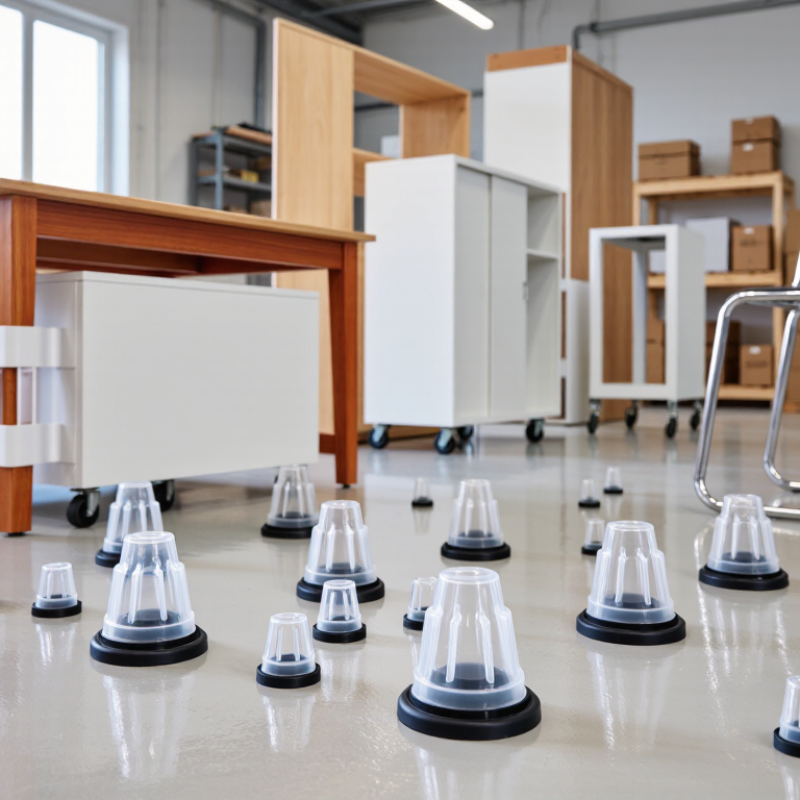
Understanding Furniture Suction Cups and Their Applications
Furniture suction cups create temporary grip without drilling holes or adding visible brackets. In furniture, they can hold glass tabletops against frames, keep small accessories from sliding, or cushion contact between smooth surfaces. A cup works best on clean, flat, nonporous material. Dust, textured coatings, and porous wood can break the seal. Small details matter.
Installation is simple, but not foolproof. Clean the surface, dry it fully, then press the cup from its center to push out trapped air. A thin film of oil can weaken the hold. So can a slightly curved tabletop. Silicone cups often remain flexible across changing temperatures, while rubber compounds may suit firm, steady contact. Neither material guarantees a fixed load capacity; diameter, surface condition, and pulling direction all affect performance. That part is easy to underestimate.
Grand View Research estimated the global furniture market at USD 677.09 billion in 2023, with projected annual growth of 5.0% from 2024 to 2030. That market figure does not measure suction-cup demand, but it signals the scale of furniture production where small fastening choices matter. For heavy glass or overhead components, suction cups should not replace structural fasteners. Check the fit after installation, and inspect for cracks or loss of elasticity. A cup can look secure and still release.
