
How to Choose the Best Fog Fountain for Your Needs?
Choosing the best Fog Fountain requires more than comparing shapes, lights, and water effects. You must match the unit with your space, climate, maintenance capacity, and visitor expectations. A small tabletop model behaves very differently from a commercial installation producing dense mist across a hotel lobby.
Public market reports rarely separate Fog Fountain systems from decorative water features, misting equipment, or indoor environmental products. This limitation matters. Grand View Research and Fortune Business Insights track broader water-feature and humidification markets, but their figures should not be treated as direct Fog Fountain sales data. A careful buyer should examine pump performance, mist output, reservoir capacity, noise levels, energy use, and replacement-part availability.
Air quality deserves equal attention. ASHRAE Standard 62.1 emphasizes adequate ventilation for acceptable indoor air quality, while the U.S. Environmental Protection Agency warns that excessive indoor moisture can encourage mold growth. Dr. William P. Bahnfleth, an indoor-air-quality specialist and former ASHRAE Epidemic Task Force chair, has stressed, “Ventilation is not a magic bullet.” The principle applies here.
A beautiful mist effect can still create problems.
Look closely at the floor around the fountain. Is it slippery? Can staff drain and clean the tank without tools? Does the controller prevent continuous operation when water levels fall? These practical details often matter more than decorative finish. The right Fog Fountain should deliver a convincing atmosphere while remaining quiet, serviceable, and suitable for its environment. Some published specifications are incomplete, so verify claims with the manufacturer before purchasing.
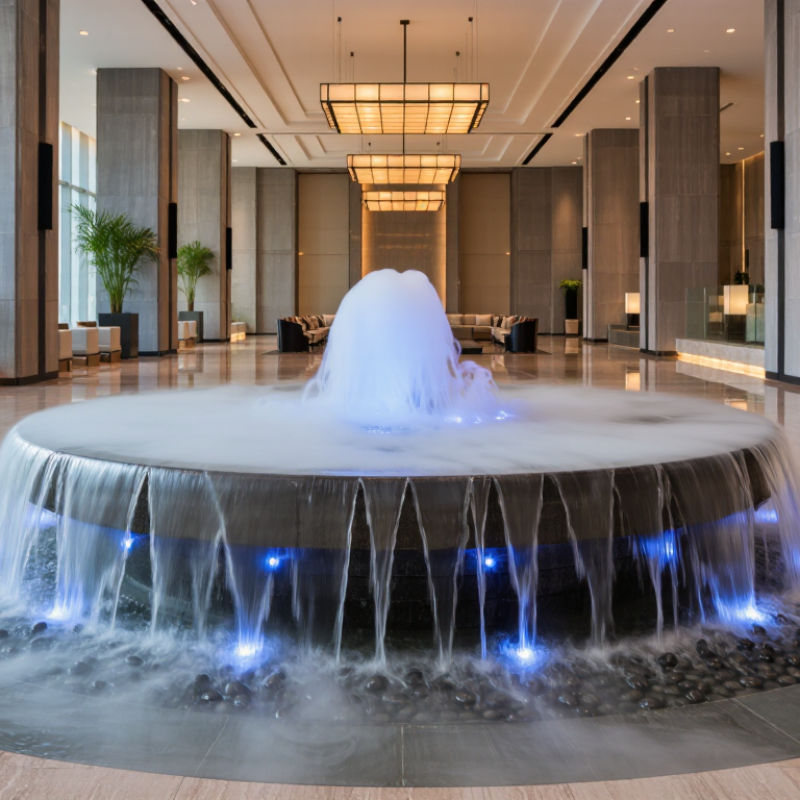
Define the Display Goal: 1.7 MHz Foggers Create 3–5 μm Mist
Choosing a fog fountain starts with the visual effect you want. A 1.7 MHz ultrasonic fogger commonly produces droplets around 3–5 μm. These droplets are fine enough to float above the water surface. They can create a soft, cloud-like layer around lights, ornaments, or small waterfalls.
The effect depends on more than frequency. Water temperature, mineral content, airflow, and basin depth all influence fog output. Hard water may leave deposits on the transducer and reduce performance. Filtered or distilled water usually supports cleaner operation.
Keep the water level within the recommended range. Too little water can damage the unit.
A 3–5 μm mist looks delicate, not dramatic. It may disappear quickly in a strong draft. Indoors, a quiet corner often gives better results than an open doorway. Colored lighting can reveal the mist, but excessive brightness may flatten its appearance. This detail is easy to overlook. The stated particle size is also an operating estimate, not a permanent guarantee. Real droplets may vary as the water warms or the transducer ages. Check the mist pattern after several hours, not only during the first test. A fountain that looks perfect in a still showroom may behave differently beside a fan, vent, or moving audience.
