
How to Choose the Best Greenhouse Covering Film in 2026?
Choosing a greenhouse cover is a crop decision, not just a purchase. Greenhouse Covering Film affects incoming light, heat retention, condensation, and how often a structure needs re-covering. Small differences matter. A cloudy morning, droplets on the inner surface, or a hot afternoon can expose weaknesses that a product brochure may not show.
The USDA National Agricultural Statistics Service reported $13.8 billion in U.S. floriculture, nursery, and greenhouse crop sales in its 2019 Census of Horticultural Specialties. That scale makes reliable crop protection an operational concern. FAO’s 2021 report, The State of the World’s Land and Water Resources for Food and Agriculture, estimates that agriculture accounts for about 70% of global freshwater withdrawals. Film does not solve water scarcity, but its light and temperature effects can influence greenhouse conditions and management.
This guide compares films by measurable properties, including light transmission, haze, UV stability, thermal performance, anti-drip treatment, thickness, and expected service life. ASTM D1003 provides a method for measuring haze and luminous transmittance in transparent plastics; EN 13206 covers thermoplastic films used in agriculture and horticulture. These references help buyers ask better questions. They do not guarantee results in every climate or crop. That part is easy to overlook. A technically impressive film may still be a poor fit if local wind, temperature swings, installation quality, or replacement costs are ignored. The best choice is the one whose documented performance matches the growing site—and whose claims can be checked.
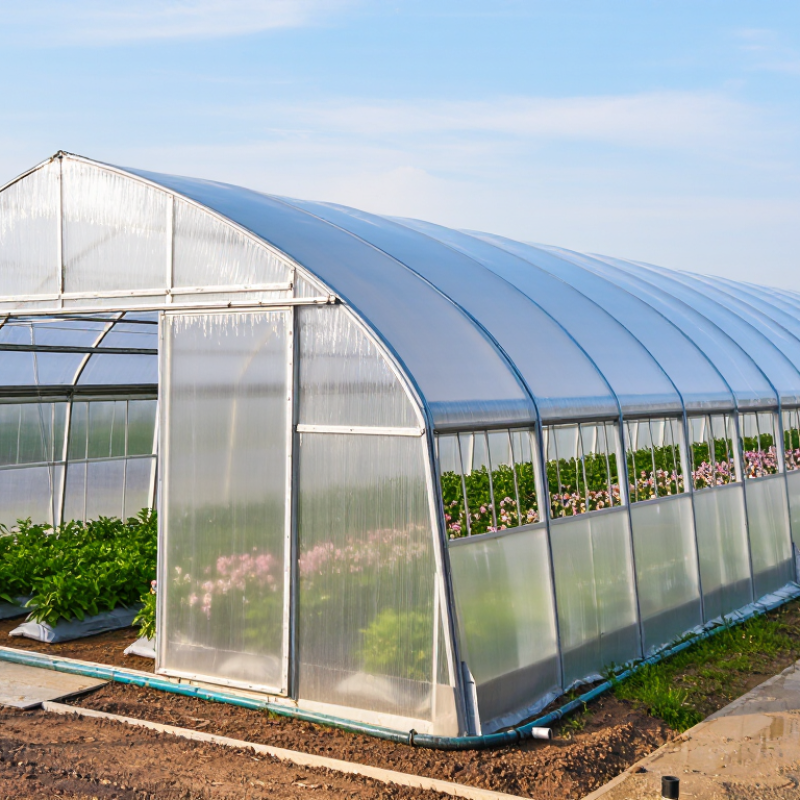
Define Greenhouse Needs, Crops, and Growing Conditions
Before selecting greenhouse covering film, define the job it must do. List your crops, planting dates, and target harvest periods. Tomatoes generally need strong light and warmth, while lettuce can suffer when temperatures rise. Then assess local conditions: summer heat, winter lows, wind, rain, and available water. NOAA’s 1991–2020 U.S. Climate Normals can help reveal seasonal temperature and precipitation patterns; check your nearest station, not just regional averages. A film suited to a mild coastal site may overheat crops in a sunny inland valley.
Tips: Sketch the greenhouse at midday and note where shadows fall. Record daily temperatures and humidity for several weeks. FAO AQUASTAT estimates that agriculture accounts for about 70% of global freshwater withdrawals, so include irrigation capacity in your planning. This global figure is not a greenhouse-specific benchmark, but it underscores why water availability matters. Compare the crop’s light needs with film light transmission and diffusion, and consider whether extra heat retention would help or cause stress. Small differences in shade can matter.
Be specific about trade-offs. A grower might want warmer nights but still need to limit scorching afternoon temperatures. I would not choose a film from crop name alone; the same crop behaves differently under different seasons, ventilation, and irrigation. Write down the conditions you can control and the ones you cannot. That list makes later film comparisons more useful—and may expose a few assumptions worth checking.
