7 Tips for Buying Mineral Wool Insulation
Choosing mineral wool is not just a matter of comparing prices per square foot. The right product must fit the wall, roof, or floor assembly, resist moisture where needed, and meet the project’s fire and sound-control goals. Mineral Wools are commonly sold as batts, boards, and loose-fill products, and each form suits different spaces. A dense board may feel rigid in your hand; a batt should fit snugly without being crushed. Small details matter.
The U.S. Environmental Protection Agency’s ENERGY STAR program estimates that air sealing and adding insulation in key areas can save homeowners an average of 15% on heating and cooling costs. That figure is a useful benchmark, not a promise: results depend on the building, climate, installation, and existing insulation. The U.S. Department of Energy also advises selecting insulation by its R-value and intended application. Check product data sheets, not just packaging claims.
Building-science expert Joseph Lstiburek emphasizes that enclosure performance depends on controlling water, air, vapor, and heat. That principle is especially useful when comparing mineral wool products, though no insulation choice fixes a poorly detailed wall. It is easy to focus on advertised performance and overlook fit, facings, or installation conditions. That deserves a second look. These seven tips will help you assess specifications, compare costs, and choose a product that suits the actual assembly—not merely the shelf label.
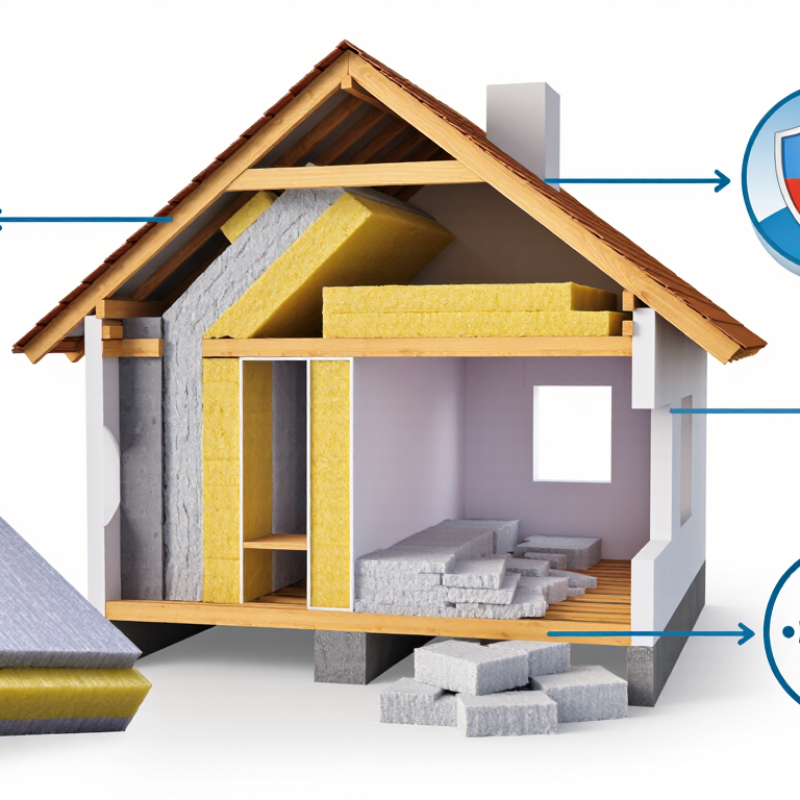
Understanding Mineral Wool Insulation and Its Main Types
Mineral wool insulation is a broad category, not one uniform product. Its two main forms are rock wool and glass wool. Rock wool is made from volcanic rock or similar minerals. Glass wool uses sand and recycled glass. Slag wool is another mineral-fiber type, although it is less common in many residential markets.
These materials differ in texture, density, handling, and thermal performance. The U.S. Department of Energy lists typical mineral wool R-values near R-3.0 to R-3.3 per inch. Glass fiber guidance shows a wider range, around R-2.9 to R-3.8 per inch. Do not compare R-value alone. A higher-density batt may resist fire and sound better, but it can require more careful cutting. Details matter.
Before buying, check the product’s declared R-value, thickness, facing, moisture exposure, and installation method. EPA ENERGY STAR guidance repeatedly pairs insulation upgrades with air sealing, because gaps can reduce real-world performance. That advice is practical, not glamorous. Measure twice. Cut once. Wear protective clothing, gloves, and eye protection during installation. Rock wool usually feels firmer and heavier, while glass wool is often easier to compress between irregular framing. Neither choice is automatically best. A perfectly rated product performs poorly when it is squeezed, left with gaps, or installed over damp materials. I still find that the label explains less than the wall assembly.
